
Evil Landfall is the latest publishing label from an indie developer
If you watched this year’s Landfall Day Stream on April 1, you might have spotted an odd moment where the Landfall logo split into two, with the familiar white logo on the left and a red logo saying “Evil Landfall” on the right.
It wasn’t a gag, but the reveal of Landfall’s new publishing arm.
The developer of Peak and Content Warning has been publishing its own games for a while, but now the internal folks in charge of publishing have announced themselves as a separate entity that will be providing funding for external games in addition to publishing Landfall’s own titles.

Kirsten-Lee Naidoo, who was head of publishing at Landfall, is now CEO of Evil Landfall. “We are seven people in total,” Naidoo tells GamesIndustry.biz. “Of that team, four are actually women, which is pretty awesome. And it’s pretty cool that they’ve asked me to be CEO, which is pretty significant because I’m South African, I’m a woman, and fairly young as well.”
Like the OG Landfall, Evil Landfall is based in Stockholm (although several staff work remotely across the world), and technically it isn’t really new. In fact, Evil Landfall was established as a separate entity for Landfall’s publishing operations around three years ago. “We realized that the publishing team and the business side of things was its own self-sustaining company,” explains Naidoo. But in reality, the two companies are inextricably intertwined. “We still have founders from Landfall as part of the Evil Landfall team as well.”

Evil Landfall didn’t reveal its existence to the world three years ago because there was no reason to – it only published Landfall’s own games, after all. Now, the ambitions have changed, and the publisher is stepping into the limelight. “We want to do more stuff, and we want to work with more cool developers, so we’re just opening the curtain a little,” explains Naidoo. “We’re not limited by just the Landfall company, we can work with anybody that we want to.”
However, that work with external companies is currently limited to providing project-based investment. Even though Evil Landfall does have the full suite of publishing services – business development, marketing, community management, and so on – it will only bring those to bear on Landfall’s own titles. Everyone else just gets the money (and a bit of advice).

That said, Naidoo does want to keep an open mind. “I think if projects come by that are interesting, that we think, ‘Oh, maybe we should publish this game, maybe it does make sense’, then we would do it. There hasn’t quite yet been an opportunity, but I think part of us becoming a more known company is opening up doors like that.”
Right now, however, she wants to keep it simple. “If you want to self-publish your games and you want Landfall’s support in terms of funding and advice, talk to Evil Landfall. If you want Evil Landfall to publish a game, that might not happen, but we’re interested to hear more.”
Undercover operation
Evil Landfall/Landfall has had a bit of practice at all this external funding malarkey already. “We never really talked about it, because it wasn’t really formalized in the way that it is now,” explains Naidoo. “One of our first investments was actually an equity investment in a studio called Semiwork on their first game, Voidigo.” The company’s second game is one you’re likely to have heard of: REPO, which gained more than 10 million monthly active users in March 2025, shortly after launching in Early Access.
“So we had been doing this for a while, just quietly,” says Naidoo. “That basically was just because they were developers in Sweden or in our ecosystem who needed funding.”
Now, those ad hoc investments have become more formal. “We have a contract and everything,” smiles Naidoo.
It’s become a trend for successful indie developers to make the leap into funding other indies. Among Us maker Innersloth launched Outersloth in 2024, and we’ve seen studios like Kinetic Games (Phasmophobia) make similar moves.
“We wanted to play on, like, ‘publisher evil, business evil’. So it just kind of stuck”
Outersloth made the rare gesture of putting its publishing contract on public display at GDC this year, but Naidoo says Evil Landfall isn’t ready to follow suit just yet. She will say, however, that there’s no 100% recoup. “We also don’t hold on to any IPs of the games that we support. I would say that gives people an idea of the type of deals that we do. It’s very hands off. Developers get to decide how involved we are, if at all.” She adds that the specific terms can change per game, which is one reason why they haven’t made the contract public – yet. “But I do think there might be a time in future where we have more to share.”
What about that name though? Why Evil Landfall? “We had talked about Landfall Presents, Landfall Invest, but all of them just felt so boring,” says Naidoo. “And Evil Landfall just felt very fun, because we’re the business arm of Landfall and we wanted to play on, like, ‘publisher evil, business evil’. So it just kind of stuck.”
Peak of their game
Of course, this ability to begin funding other indies is down to Landfall’s own astonishing success with titles like Totally Accurate Battle Simulator (TABS), Content Warning, and particularly Peak, which Video Game Insights estimates has sold more around 17 million units so far.

Naidoo says that the phenomenal sales of Peak took Landfall by surprise. “We’re a studio that has already had quite a lot of success in the past, and we didn’t actually think that we could get more successful in a way. It was like, we’ve already made games that have reached millions of people. How much bigger could it possibly get?”
Peak was made over the course of just a few months in collaboration with Aggro Crab. “And then we released it, and it was immediately the fastest selling game, and now has eclipsed all of our other projects,” says Naidoo. “It was really surprising.” She says they had expected it to do similar sales to Content Warning, which features a similar kind of cooperative gameplay.
She’s particularly pleased for Aggro Crab. “We came from having a bunch of success already. Peak was just like, ‘Oh, another one’. For Aggro Crab, Peak is the reason why the studio gets to continue, because their games are getting cancelled and the rest of it. But because of Peak, they get to continue. And that was the best part. It was like, OK, this makes it worth it.”
In terms of the kinds of projects Evil Landfall is interested in funding, Naidoo says they’re mostly looking for games that are similar to Landfall’s own titles. “We feel like we already have an audience established that likes games to play with friends: silly, physics-based projects. We look for games in this realm, because we think that if we boost them to our audience, then there’s an added benefit there.”
“We haven’t really considered supporting, like, a narrative game, because we don’t really know how those games function and how to sell them. We don’t have experience there.”
The label has been signing games with short development cycles, just like Peak’s. “We have lots of devs who are looking at our model and saying, ‘Let’s try to find the core of the game in a month and work on it for, like, six months max and then ship’. So we’ve been experimenting and signing some of those projects to see how they go. When those projects ship, we’ll decide if that’s sustainable for people outside of Landfall, and then we’ll kind of mould it from there.”

Peak has clearly been inspiring developers: a phenomenal success thrown together in an astonishingly short time, the antithesis of the prevailing wisdom that games take longer and longer to make with each passing year thanks to the continuous march towards ever-higher graphical fidelity. “We have so many people pitch us games that are like, ‘This is like Peak, please fund it’,” says Naidoo. “And I think that it’s good, because I think that we really believe in making games this way.
“We believe that you shouldn’t spend multiple years on a project, because we’ve noticed that we often get caught up in the spiral. Our developers have been like, ‘We work on a project for years, and we keep going deeper, and it doesn’t really go anywhere’. That’s not a good feeling.
“If you work on a project for six months and it doesn’t end up being anything, you can move on”
The better approach has been “‘We want to find the core of the game really quickly and have a shorter development cycle, because that’s really fresh and that’s really interesting’. And we all think that that model is better, because it just eliminates so much risk. If you work on a project for six months and it doesn’t end up being anything, you can move on. It’s not a huge time and money thing.”
She wants the developers Evil Landfall signs to follow a similar philosophy. “If you’re not finding the core of the game in a few months, don’t sink five, six years into this. Don’t put your life savings into it. Rather, put it out there, let people play it, if it doesn’t stick, move on.”
Early audience testing
Mobile game developers have been following a similar process for years now, testing games with audiences very early in development, and quickly ditching concepts that don’t click. The same process is now gradually being applied to PC and console games: Avalanche Studios recently told GamesIndustry.biz about its new, survival of the fittest-style prototype playtesting program.
Naidoo says this kind of early audience testing approach was used for some of Landfall’s earlier titles. “TABS was a game that was made by putting it in front of the community and seeing how they respond to it.” But as Landfall became more confident about what would be a hit and what wouldn’t, the company didn’t feel such a need to go through that kind of iterative development in front of audiences: hence why Content Warning was a shadow drop.
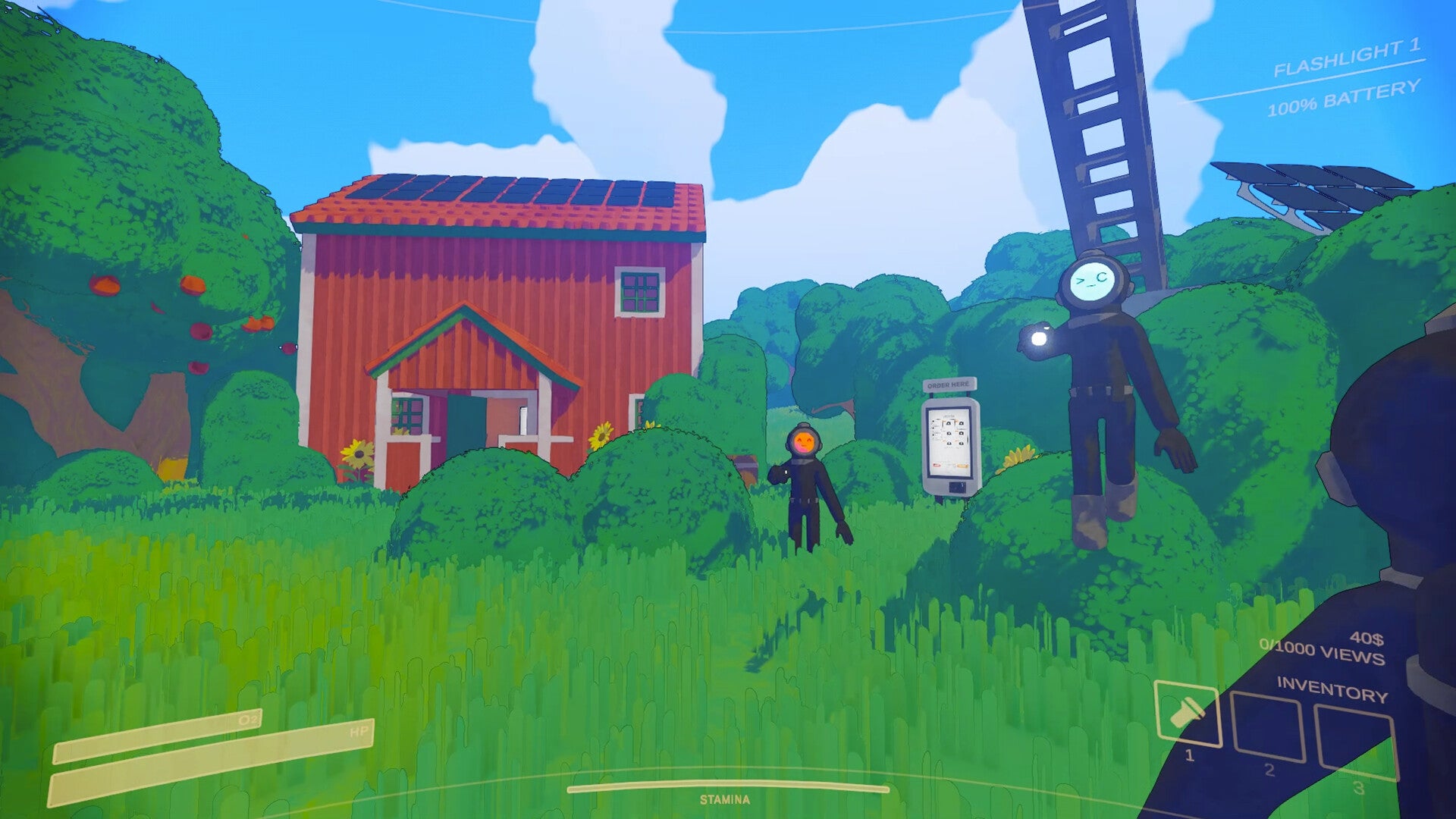
“With Peak, we had thought about shadow dropping it,” says Naidoo. “We teased it a bit beforehand. We didn’t really let people play it, other than a small group of testers. And I think that we are getting a really good eye for what might do well and what might not. But for the developers that we invest in, it’s a little bit harder, because they don’t have that kind of intuition that you get from making and releasing a lot of games.
So with the games that we invest in, I particularly ask, ‘Has anybody played this? Have you got this in front of the audience, and how have they responded to it?’ We think it’s a really important part of development. I think that too many developers develop their game secretly for several years and just go with it, without showing it to anyone, and that doesn’t always go very well. But if you get your game in front of people, they’ll probably give you feedback that will steer you in the right direction early on.”
Naidoo says Evil Landfall wants to invest in “a few games a year,” with funding levels per game going up to around $1 million. “It can be above that, but it’s on a case by case basis.” She reveals one title that Evil Landfall has already invested in – How To Fish from Dazed Games, which is due for release later this year – but the other titles are under wraps. She describes the game as “very silly” and “very chaotic,” which is exactly the type of game Evil Landfall wants to invest in.

Naidoo is excited to reveal Evil Landfall to the world, but she’s equally aware that it will no doubt result in a tsunami of submissions for the new publisher. “I don’t think we’re prepared for this,” she laughs. “I think that we will learn a lot, and we’ll have to change our systems to make them work better for scale.”
She’s also excited about giving developers freedom to operate outside a traditional ‘all-in’ publishing agreement. “I think that’s a big thing. People get to decide, ‘If I have money, what do I want to outsource? What don’t I want to outsource? What do I want to learn for myself?’ Which is not really an option we’ve had in the past, but now there’s a lot more control. And we’re very interested in developers who are interested in all sides of the business, because we want to help them be sustainable in the long term and not just have a publisher do everything – and then they ship the next game and they don’t have any idea how to do that. We’re trying to set studios up for success.”





Add comment